Farmer-led Seed Systems at the Heart of the 53rd Plenary of the Committee on World Food Security (CFS) 53 from 20th to 24 October 2025 – By Vanessa Black, Biowatch South Africa
As governments and civil society gathered in Rome for the 53rd Plenary of the Committee on World Food Security (CFS), the global hunger crisis once again took centre stage. The State of Food Security and Nutrition in the World 2025 report confirmed that between 638 and 720 million people faced hunger in 2024, reinforcing a reality long voiced by small-scale food producers: the dominant food system is failing to feed people equitably.
Ahead of the plenary, the Civil Society and Indigenous Peoples’ Mechanism (CSIPM) convened to analyse the structural drivers of hunger. Farmers, pastoralists, Indigenous Peoples and seed custodians pointed to deepening inequality, climate change, biodiversity loss, land grabbing and environmental degradation pressures intensified by industrial agriculture and corporate control over seeds and food systems. Ongoing conflicts in Sudan, the Democratic Republic of Congo, Ukraine and Palestine were cited as stark examples of how food, land and seed systems are deliberately disrupted during war.
Marking the 10th anniversary of the Framework for Action for Food Security and Nutrition in Protracted Crises, CSIPM urged States to end the weaponisation of food and seeds, including addressing the man-made famine in Gaza highlighted by the IPC Famine Review Committee. For many farming communities, losing seeds and control over planting cycles is the first step toward prolonged hunger and dependency.
A key outcome of the plenary was the endorsement of the CFS Policy Recommendations on Strengthening Urban and Peri-Urban Food Systems. Importantly for FMSS advocates, the recommendations acknowledge the rural–urban continuum, recognising that seeds, food, and knowledge flow between rural producers and urban communities. The text supports inclusive land tenure, participation, agency, informal markets, and explicitly references food sovereignty. For the first time, “traditional gatherers” are formally recognised – a meaningful step towards valuing Indigenous and community-based food systems rooted in biodiversity. Civil society noted gaps, including weak reluctance to recognise women’s central role in seed saving and exchange and the failure to recognize the inherent rights of Indigenous Peoples, including self-determination and prior and informed consent.
For SKI these conversations strongly echoed long-standing work on farmers’ rights and that food security is built on people’s agency – not by global corporations. While CFS outcomes do not automatically translate into national policy change, they carry significant political weight and strengthen the legitimacy of farmer-led seed work and agroecology, and provide an important reference point for advocacy at regional and national levels.
Looking ahead, the challenge lies in ensuring that this recognition is reflected in concrete policy and practice. For farmer-led seed systems to thrive and enable the bottom up transformation which is possible, continued vigilance, alliance-building and grounded evidence from farmers themselves will remain essential.
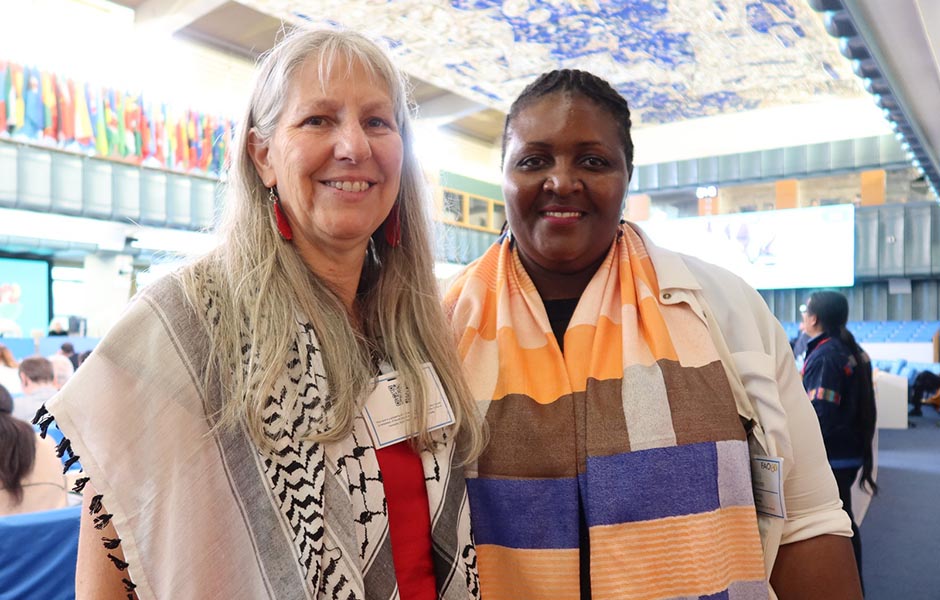
SKI was represented by Vanessa Black of Biowatch South Africa and SKI’s CFS champion, Precious Phiri of Igugu Trust, who carried forward the voices and demands of farmers, seed custodians and civil society from the region and ensured farmer-led seed systems remained visible as a political solution. The week concluded with appreciation for H.E. Nosipho Nausca-Jean Jezile of South Africa as she completed her term as CFS Chair.
You are encouraged to join current CSIPM working groups to participate in the work of the CSIPM (https://www.csm4cfs.org/policy-working-groups/) and check the CFS HLPE website for opportunities to input into the research that informs current policy processes (https://www.fao.org/cfs/cfs-hlpe/consultations/en).


